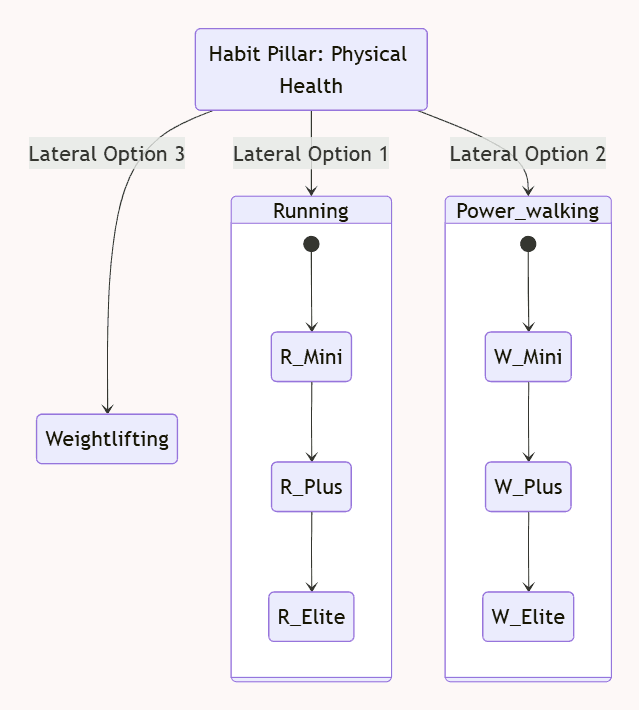
Elastic habits horizontal options:
Tired of failing at rigid routines? Explore the Elastic Habits framework to build a resilient system that adapts to your energy levels and eliminates guilt.
2/2/2026
Written by: Aware Ascent
We have all been there: It’s Monday morning, your motivation is at an all-time high, and you commit to a rigorous new routine. “I will meditate for 30 minutes, run 5 miles, and read 50 pages every single day.”
For a few days, it feels transformative. But then, life happens. You get a poor night’s sleep, an emergency meeting is called, or you simply feel drained. You miss one day. The “streak” is broken. Suddenly, the entire habit feels like a burden, and by Friday, you’ve quit entirely.
This is the failure of Rigid Habits. Most habit advice treats routines like glass—strong and impressive, but brittle. If you can’t meet the high standard you set, the habit shatters.
Stephen Guise, a leading researcher in behavioral strategy, proposes a radical alternative: Elastic Habits. Instead of building routines like glass, we should build them like rubber bands. This guide explores how to create a habit system that is literally “too flexible to break.”
Credit Notice: This post explores the core philosophy and practical frameworks found in the book Elastic Habits by Stephen Guise. The concepts of Vertical and Lateral flexibility and the Three-Tier success system discussed below are based on his innovative research into habit resilience.
The central problem with traditional goal-setting is that it assumes every day is the same. It ignores the reality of human fluctuation. Guise argues that rigidity is the enemy of consistency. When you have a single, high-bar goal, you create a binary outcome: Success or Failure.
An Elastic Habit is designed to have multiple “win states.” It recognizes that your “best” on a day when you are sick is different from your “best” on a day when you are energized.
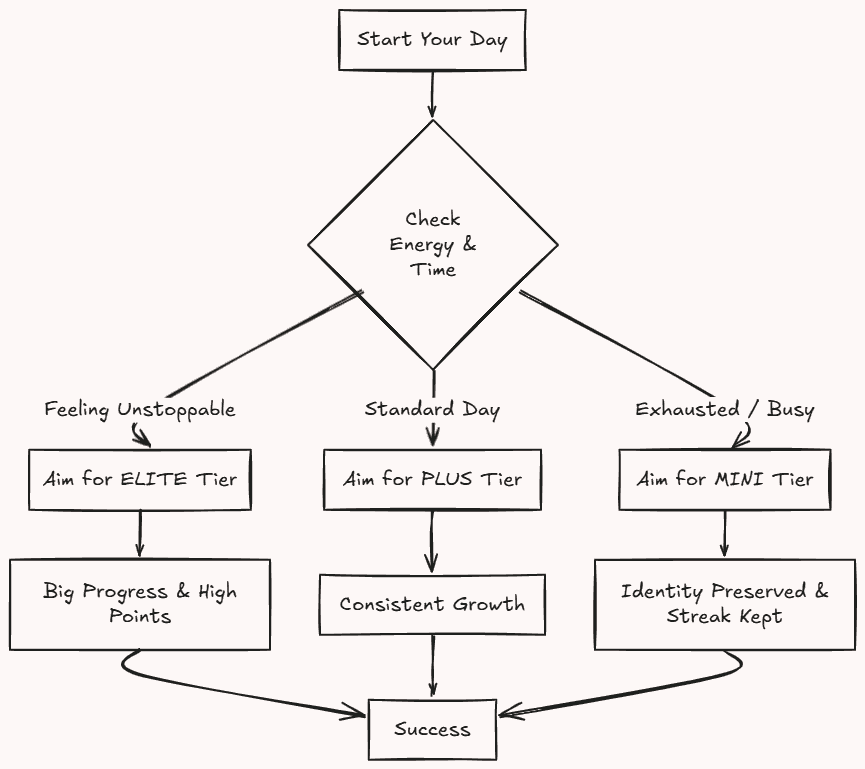
The engine of the Elastic Habit system is the Three-Tier Matrix. Instead of one goal, you define three levels of success for every habit.
| Level | Intensity | Objective | Example (Exercise) |
|---|---|---|---|
| Mini | Low | Keep the streak alive with “stupid simple” effort. | 1 Push-up or 1 min walk. |
| Plus | Moderate | A respectable, average day’s work. | 20 Push-ups or 15 min jog. |
| Elite | High | Capitalize on high energy and peak motivation. | 50+ Push-ups or 45 min run. |
The Mini is your safety net. It requires almost zero willpower. By doing a Mini on your worst day, you maintain the neural pathway of the habit and protect your identity as someone who “never misses.”
Sometimes the problem isn’t the intensity of the habit, but the mode. If your goal is “Personal Growth,” you might not feel like reading today, but you might feel like listening to a podcast or journaling.
Lateral Flexibility allows you to have multiple ways to satisfy a single habit category. This prevents boredom and allows you to adapt to your environment.
| Level | Option A: Reading | Option B: Journaling | Option C: Meditation |
|---|---|---|---|
| Mini | Read 1 page | Write 1 sentence | Meditate 1 min |
| Plus | Read 15 pages | Write 1 page | Meditate 10 mins |
| Elite | Read 1 chapter | Write 3 pages | Meditate 20 mins |
In this matrix, any single box counts as a “win.” On a chaotic day, you might just write one sentence (Mini Journaling). On a great day, you might read a full chapter (Elite Reading).
Why does this system outperform traditional discipline? It leverages key psychological drivers:
| Feature | Rigid Habits | Elastic Habits |
|---|---|---|
| Structure | One fixed goal (Static) | Multiple tiers and options (Fluid) |
| Failure Rate | High (Life interrupts perfection) | Near Zero (Always a way to win) |
| Mindset | All-or-nothing | Progress-focused |
| Energy Required | Constant high willpower | Matches your current state |
| Long-term Result | Burnout or quitting | Resilient, lifelong consistency |
We often mistake “rigidity” for “strength.” We think that being hard on ourselves is the only way to improve. But true strength is the ability to adapt. A skyscraper that cannot sway in the wind will collapse in a storm; one that is designed to flex will survive.
The Elastic Habit framework is about more than just productivity—it’s about self-compassion. It’s an admission that you are a human being with varying needs and capacities. By giving yourself the freedom to scale your efforts, you ensure that you never stop moving forward.
Stop trying to be perfect. Start being elastic. Pick one habit today, define your Mini, Plus, and Elite tiers, and give yourself the permission to win.
Elastic habits vertical options:
Elastic habits horizontal options: