The Path to Mastery: Robert Greene’s Blueprint for Ultimate Excellence
Unlock the secrets of high performance with our deep dive into Mastery by Robert Greene. Learn the rules of the apprenticeship phase, social intelligence, and the creative-active mind.
1/28/2026
Written by: Aware Ascent
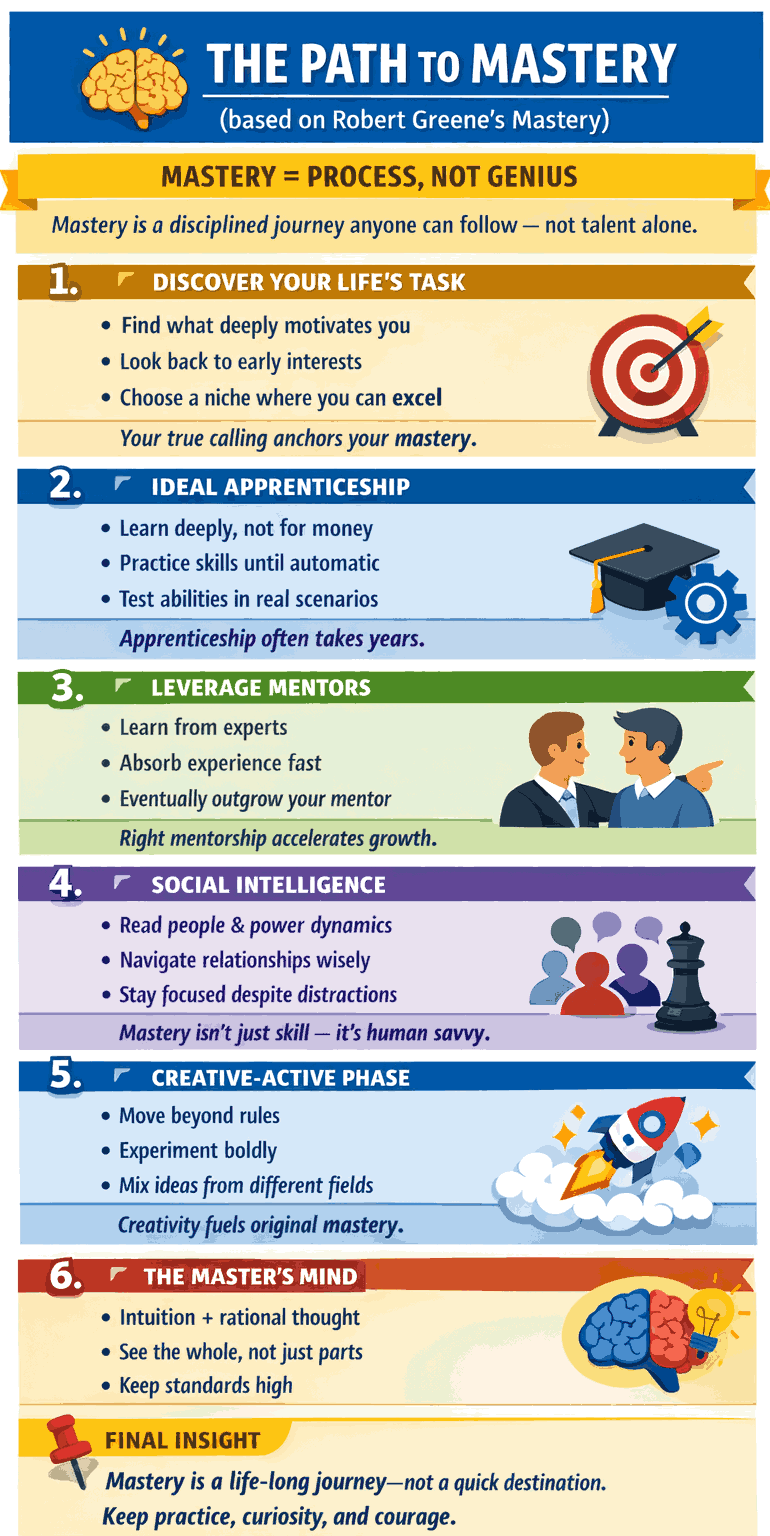
Mastery is not a function of genius or talent; it is a process that anyone can follow. In his definitive work, Mastery, Robert Greene argues that the path to greatness is a systematic journey through specific phases of development. While society often celebrates the “overnight success,” the reality is a long-term commitment to discipline, social intelligence, and intense focus.
This guide explores the fundamental rules of the Mastery process, focusing on the tactical laws of skill acquisition and the psychological shifts required to reach the pinnacle of any field.
Credit Notice: This post explores key insights and core principles derived from the book “Mastery” by Robert Greene. The concepts of the Life’s Task, the Ideal Apprenticeship, and Social Intelligence discussed below are based on his extensive research into the lives of historical and contemporary masters.
1. Discover Your Life’s Task: The Primal Inclination
Before you can master a field, you must identify your “Life’s Task.” This is an internal force that pulls you toward a specific subject or activity. Greene suggests that every individual has a unique “primal inclination” that surfaced in childhood.
Rules for Identifying Your Calling
- Return to Your Origins: Look back at what obsessed you before you were influenced by parents or peers.
- The Side Niche Strategy: Occupy a niche. In a crowded world, find a “side branch” of a major field where you can be the undisputed expert.
- The Rebellion Strategy: If you find yourself in a career for the wrong reasons (money, prestige), you must have the courage to break away and return to your core interests.
2. The Ideal Apprenticeship: Learning Over Earning
Once you have chosen your field, you enter the Apprenticeship Phase. The goal of this phase is not money or status; it is transformation. Greene sets the duration for this phase at roughly 7–10 years.
The Three Steps of the Apprenticeship:
- Deep Observation (The Passive Mode): Spend the first months observing the power dynamics and the “hidden rules” of your industry. Do not try to impress; try to understand.
- Skills Acquisition (The Practice Mode): Focus on one skill at a time. Mastery is built through tedious, repetitive practice until the skill becomes “hard-wired” into your nervous system.
- Experimentation (The Active Mode): As you gain proficiency, start testing your skills in real-world scenarios. Take on small projects to see how your knowledge applies.
Rules for the Perfect Apprenticeship:
- Value Learning Over Money: Choose a position that offers the most opportunities for learning and growth, even if it pays significantly less.
- Keep Expanding Your Horizons: Never settle for a narrow set of skills. Look for ways to integrate different disciplines.
- Move Toward Resistance: Seek out the hardest parts of the job. By embracing the pain of learning, you accelerate your growth.
3. The Power of Mentorship: The Shortcut to Greatness
A mentor is the single greatest tool for accelerating your path to Mastery. A mentor allows you to absorb their years of experience in a fraction of the time, functioning like a “shortcut” through the apprenticeship.
Rules for the Mentor-Protégé Relationship:
- Choose the Right Mentor: A mentor should fit your specific needs and personality. They should be someone who has already achieved what you desire.
- The Back-and-Forth Strategy: Initially, be a sponge. Absorb everything. As you grow, begin to offer your own insights and help the mentor in return.
- Surpass the Mentor: The ultimate goal of a protégé is to eventually break away and surpass the mentor. You must take their knowledge and refine it with your own unique perspective.
4. Social Intelligence: Navigating the Human Element
Technical skill alone will not lead to Mastery. You must also navigate the complex world of human emotions and power dynamics. Greene warns that “fools” and “envious types” can derail your career if you are not careful.
The Two Dimensions of Social Intelligence:
- Specific Knowledge: Understanding the specific people you work with — their motivations, insecurities, and hidden agendas.
- General Knowledge: Understanding human nature as a whole — how envy, pride, and group-think influence behavior.
Rules for Navigating People:
- See People as They Are: Stop projecting your own emotions onto others. Observe them objectively.
- Craft the Right Persona: You must fit in socially while remaining a master of your craft. Do not be overly eccentric until you have achieved significant power.
- Suffer Fools Gladly: Do not waste energy arguing with people who are beneath your level of ambition. Ignore them and stay focused on your work.
5. The Creative-Active Phase: Expanding Your Mind
As your apprenticeship ends, you must transition into the Creative-Active Phase. This is where you move from following rules to breaking them. You must cultivate what Greene calls the “Dimensional Mind.”
Rules for Creative Brilliance:
- The Primitive Mind: Maintain a sense of wonder. Do not let your technical expertise make you rigid or cynical.
- Negative Capability: The ability to endure uncertainty and mystery without reaching for a premature conclusion. Let ideas marinate before judging them.
- The Alt-ternative Perspective: Look at your field from a completely different angle. Mix disciplines — like biology with architecture — to create something truly original.
6. The Master’s Intelligence: Fusing Intuition and Rationality
The final stage is Mastery itself. At this level, you have practiced your craft for so long that it has become an extension of your body. You no longer need to “think” about what to do; you simply know.
Rules for Sustaining Mastery:
- Trust Your Intuition: Mastery allows you to see the “whole” rather than just the parts. Trust the gut feelings that come from years of experience.
- Maintain High Standards: The greatest enemy of the Master is complacency. Always look for new challenges to keep your mind sharp.
- Connect With the Whole: Understand how your work fits into the larger world. Masters are often the ones who see the trends before they happen.
Summary Table: The Laws of Mastery
| Phase | Goal | Key Rule |
|---|
| Discovery | Find your Life’s Task | Trust your primal inclinations. |
| Apprenticeship | Skill Acquisition | Value learning over earning. |
| Mentorship | Accelerated Growth | Absorb the mentor’s life-lessons. |
| Social Intelligence | Power Navigation | See people as they are, not as you wish. |
| Creative-Active | Originality | Cultivate a “Dimensional Mind.” |
| Mastery | Intuition | Fuse rationality with high-level instinct. |
Conclusion: The Long Road to Greatness
Mastery is not a destination; it is a way of life. It requires the patience to endure years of apprenticeship, the social intelligence to navigate human nature, and the creative courage to forge your own path.
As Robert Greene emphasizes, the greatest power you can ever possess is the power of yourself — fully realized through the rigorous pursuit of your craft. Stop looking for shortcuts. Embrace the process, follow the rules, and you can eventually reach the level of the Master.