The Remarkable Edge: Seth Godin’s Blueprint for Standing Out in a Boring World
Why being 'very good' is a death sentence in modern marketing. Discover the core principles of Seth Godin's The Purple Cow and learn how to build a brand that is truly remarkable.
1/29/2026
Written by: Aware Ascent
In a world saturated with noise, being “very good” is the same as being invisible. For decades, businesses relied on a simple formula: buy ads, get distribution, sell products, and reinvest in more ads. Seth Godin calls this the Television-Industrial Complex. But that cycle is broken. Today, consumers are too busy to notice your traditional marketing and too cynical to care about your “slightly better” features.
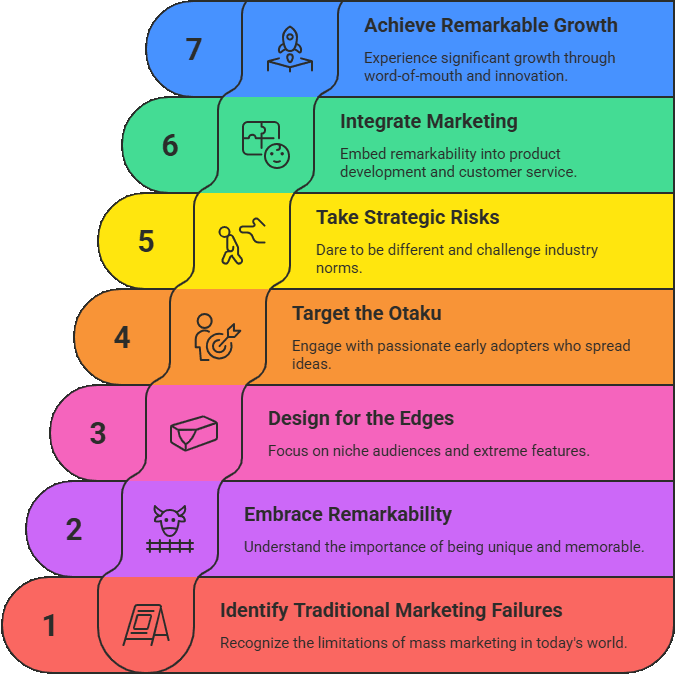
In his seminal work, The Purple Cow, Godin argues that the only way to survive is to be remarkable. You need to be the Purple Cow in a field of brown ones. This guide breaks down the tactical shift from mass marketing to niche obsession, and how you can bake “remarkability” into your product from day one.
Credit Notice: This post explores key insights and core principles derived from the book “The Purple Cow” by Seth Godin. The concepts of the Five Ps, the Idea Diffusion Curve, and the “Safe is Risky” paradox discussed below are based on his revolutionary approach to modern business growth.
1. The New ‘P’: Why Traditional Marketing is Broken
For years, marketers relied on the “Five Ps”: Product, Price, Promotion, Place, and People. While these are still functional, Godin argues they are no longer sufficient. To succeed today, you must add a new P: The Purple Cow.
The Problem with “Very Good”
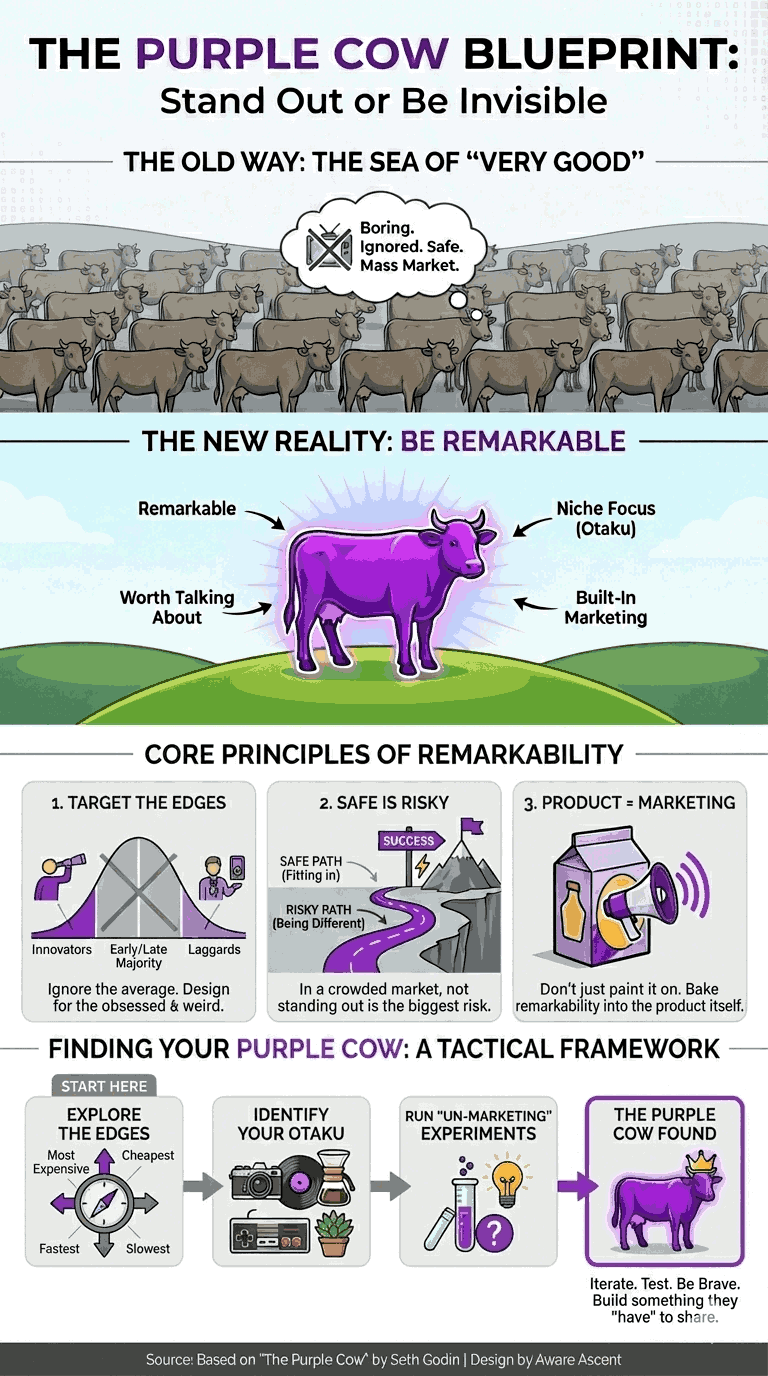
- The Brown Cow Effect: If you see a field of brown cows, they are interesting for about thirty seconds. Then they become boring. “Very good” is a brown cow. It is what people expect, so they don’t bother talking about it.
- The End of Mass Media: You can no longer buy your way into the consumer’s mind. With the rise of ad-blockers, streaming, and social media fragmentation, the “interrupt and sell” model is failing.
- Consumer Saturation: We have too many choices and too little time. We only pay attention to things that are truly exceptional or solve a specific, burning problem.
Most companies design a “safe” product and then hand it to the marketing department to “make it interesting.” Godin suggests this is a recipe for failure. Remarkability must be baked into the product itself.
- Design for the Edges: Don’t try to please everyone. If you make a product for the “average” person, you’ll end up with something bland. Instead, design for the obsessed, the weird, or the extreme.
- The “Worth Talking About” Test: If someone uses your product, will they tell a friend? If the answer is “maybe,” you aren’t a Purple Cow yet.
- Ignore the Critics: To be remarkable is to be criticized. If you aren’t upsetting someone, you’re probably being too safe.
3. The Idea Diffusion Curve: Targeting the Otaku
One of the biggest mistakes businesses make is trying to market to the “Early Majority” and “Late Majority” (the middle of the curve). These people are resistant to change and won’t listen to you.
How to Spread Your Idea:
- Find the Innovators and Early Adopters: These are the people who are actively looking for something new. They have a “sneezier” quality—they love to share their discoveries.
- Target the “Otaku”: This is a Japanese term for someone with an obsessive interest. Whether it’s specialty coffee, enterprise software, or urban gardening, find the people who are obsessed with your niche.
- Cross the Chasm: You don’t get the mass market by advertising to them. You get them by having the Early Adopters “sneeze” your idea onto them until it becomes the new standard.
4. The Paradox of Risk: Safe is Risky
In a crowded marketplace, fitting in is a failure. In a busy marketplace, not standing out is the same as being invisible. Therefore, the “safest” thing you can do is also the riskiest.
The Rules of Strategic Risk:
- The Boredom Tax: If you play it safe, you pay a “tax” in the form of massive ad spends just to be noticed.
- The Leader is the Leader Because They Were Brave: Look at the market leaders in any niche (Tesla, Apple, Dyson). They didn’t get there by copying the previous leader; they got there by doing something that seemed “risky” at the time.
- Be the Outlier: If everyone is lowering prices, raise yours. If everyone is going digital, send hand-written letters. Find the “standard” and pivot 180 degrees.
5. The Death of the Marketing Department
Godin argues that marketing is too important to be left to the marketing department. In a Purple Cow company, the “marketer” is the product designer, the customer service rep, and the CEO.
Shifting the Organizational Mindset:
- Stop Advertising, Start Innovating: If you have $100,000 to spend, don’t buy a billboard. Spend that money on a product feature that is so cool people have to talk about it.
- Identify Your “Sneezers”: Who are the 100 people who can influence 10,000? Spend your energy making those 100 people happy.
- Measure Everything: Use data to find out what is actually remarkable. If a feature isn’t sparking conversation or growth, kill it and try a different “purple” experiment.
6. How to Find Your Purple Cow: A Tactical Framework
Finding a Purple Cow isn’t about a single “eureka” moment. It’s a process of iterative experimentation.
The Discovery Checklist:
- Go to the Edges: What happens if we make it the most expensive? The cheapest? The fastest? The slowest?
- Explore the “Un-Marketing” Strategy: What if we had no ads at all? How would people find us?
- The “Opposite” Exercise: List the top 5 industry standards. Now, imagine a product that does the exact opposite of all five. Is there a niche for that?
- Focus on the “Smallest Viable Market”: Don’t try to win the world. Try to win one specific room. If you can’t be a Purple Cow to 1,000 people, you’ll never be one to a million.
Summary Table: The Purple Cow vs. The Brown Cow
| Feature | The Brown Cow (Traditional) | The Purple Cow (Remarkable) |
|---|
| Primary Goal | To be “Very Good” | To be Remarkable |
| Target Audience | The Mass Market | The Otaku / Early Adopters |
| Risk Profile | Avoids criticism / Safe | Embraces polarities / Risky |
| Marketing Spend | High (Buying attention) | Low (Earning attention) |
| Product Lifecycle | Slow, steady decline | Rapid growth via “Sneezers” |
| Core Philosophy | Fitting in is winning | Fitting in is failing |
Conclusion: Will You Be Noticed?
The lesson of the Purple Cow is simple but terrifying: You cannot be “normal” and expect extraordinary results. The world has too many options for consumers to settle for a product that is just “fine.”
As Seth Godin reminds us, the opposite of “remarkable” is “very good.” If your business is merely very good, you are already on the path to obsolescence. You must have the courage to be different, the discipline to target the right niche, and the vision to build remarkability into everything you do.
Don’t wait for permission to be remarkable. Start looking for the edges of your industry, find your Otaku, and give them something worth talking about.